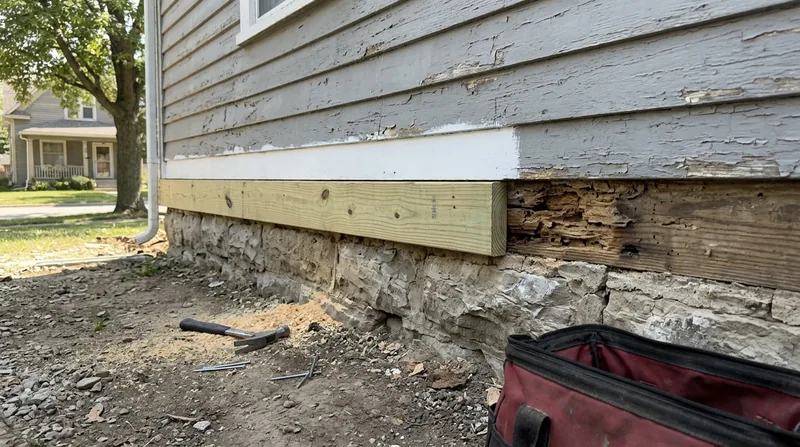




Wood Rot & Dry Rot Repair in Olathe is a critical maintenance issue for the city's aging Victorian and foursquare homes around the courthouse square, the 1950s brick-and-frame ranches east of downtown, and the 1970s-80s split-levels and raised ranches that dot Havencroft and the neighborhoods off Santa Fe. Olathe's true four-season climate, with freeze-thaw winters, ice dams on eaves, and hot, humid summers punctuated by violent spring thunderstorms, creates ideal conditions for wood decay in siding, fascia, trim, and structural framing. Swollen, delaminating hardboard lap siding, rotted fascia under overflowing gutters, soft deck ledgers on walkout decks, and cracked window sills are the everyday failures we see. Heavy, expansive clay beneath every house keeps basement rim joists and sill plates damp year-round, and carpenter ants follow that moisture into framing. We cut out decayed wood, treat surrounding lumber, and rebuild with rot-resistant material, a permanent structural repair, not a cosmetic patch. If you're seeing soft spots in exterior trim, sagging fascia, or soft framing in a basement, call us at (913) 355-6186 for a free estimate, or learn more about related structural issues on our floor joist and subfloor repair page.
Why Wood Rot & Dry Rot Repair Matters in Olathe's Older Homes
Olathe's oldest neighborhoods, built in the late 1800s and early 1900s, contain wood-frame houses with tall windows, wooden porches, and clapboard siding that were never designed to survive a century of Kansas weather. The city's freeze-thaw cycles split wood fibers, ice dams trap water behind gutters, and spring thunderstorms drive rain sideways into joints and trim. Wood rot doesn't happen overnight, but it accelerates quickly once moisture penetrates the outer layer. A soft spot in a fascia board or a cracked window sill can hide decay that reaches deep into the framing, where it weakens rim joists, sill plates, and floor structure. Catching rot early and removing only the decayed wood, then rebuilding with pressure-treated lumber or rot-resistant species, stops the spread and preserves the original framing.
- We inspect the full depth of affected wood using a probe or moisture meter to determine how far decay has traveled.
- We remove all soft, discolored, or crumbly wood and treat the surrounding sound lumber with a wood preservative.
- We rebuild the damaged section with pressure-treated lumber, rot-resistant species like redwood or cedar, or Douglas fir, matching the original profile and finish.
- We address the moisture source, whether that means clearing gutters, improving drainage, or fixing a roof leak, so rot does not return.
Early intervention saves money, prevents structural failure, and keeps your home's frame solid for decades.
Key info: Olathe's heavy clay soils swell when wet and shrink in drought, causing doors to rack and basement rim joists to stay damp. This constant moisture cycle is the leading cause of wood rot in the city's basements and crawl spaces. We repair rot-damaged rim joists and sill plates before they compromise the structural integrity of the house.
For more information on related structural damage, see our page on termite damage repair, which often occurs alongside wood rot in damp basement framing.
How We Repair Wood Rot & Dry Rot in Olathe: Our Process
Every wood rot repair starts with a careful inspection to understand the full scope of decay. We use a sharp probe to test the depth and spread of soft wood, take moisture readings, and photograph the damage so you can see what we're working with. Once we've mapped the rot, we explain whether repair is the right answer or whether the affected member should be replaced entirely. For most jobs, we can save the original framing by cutting out the decayed section, treating the exposed sound wood, and sistering in new lumber or patching with rot-resistant material that matches the original thickness and grain.
- We open the wall, siding, or trim to expose the full extent of decay without unnecessary damage to sound wood.
- We cut out all soft, discolored, or compromised material using chisels, saws, and hand tools for precision.
- We treat the remaining sound wood with a wood preservative to arrest any incipient decay and protect against future moisture.
- We install new lumber, cut and fitted to match the original profile, grain, and finish, securing it with corrosion-resistant fasteners.
- We seal all joints and end grain with exterior-grade caulk or paint to prevent water intrusion.
- We restore the exterior surface, whether that means refinishing trim, replacing siding, or repainting to match the existing color and sheen.
This approach preserves the structural integrity of your home while maintaining its original character and detail.
Example: A 1970s raised ranch in Havencroft had a soft spot in the fascia under a gutter that overflowed every spring. We removed 18 inches of rotted 1x8 fascia, treated the rim joist behind it, and installed new pressure-treated fascia with a metal drip edge and properly pitched gutters. The repair cost $1,200 and took one day. Replacing the entire fascia would have cost three times as much and been unnecessary.
For more complex structural issues, see our page on beam replacement and load-bearing wall removal.
Wood Rot Repair Methods and When to Use Each
| Approach | Description | Best for |
|---|---|---|
| Localized cut-and-patch | Remove decayed section, treat surrounding wood, install new lumber or epoxy patch matched to original profile. | Small pockets of rot in trim, fascia, window sills, or non-structural framing where the sound wood is strong. |
| Sistering and reinforcement | Install a new timber alongside the decayed member, bolted or fastened securely to share the load and restore strength. | Rot in floor joists, rim joists, or other load-bearing framing where removal would weaken the structure. |
| Full member replacement | Remove the entire rotted beam, joist, or post and install new pressure-treated or rot-resistant lumber to original dimensions. | Extensive decay affecting more than half the depth of a structural member, or rot so deep that repair is weaker than replacement. |
| Epoxy consolidation and reinforcement | Inject epoxy resin into soft wood to harden it, then reinforce with new wood or fiberglass straps where structural loads are moderate. | Historic trim, ornamental posts, or architectural details where original material must be preserved for character or heritage value. |
Wood Rot & Dry Rot Repair Cost in Olathe: What to Expect
Wood rot repair in Olathe typically starts at $650 for a small, localized job such as a rotted window sill or a small section of fascia. The final price depends on how much wood is decayed, how deep the rot travels, how accessible the damage is, and whether the affected member is structural or decorative. A soft spot in exterior trim on a one-story ranch is quick and inexpensive. Rot in a basement rim joist, a deck ledger, or a floor joist requires more labor, may need temporary bracing, and could involve sistering or partial replacement, which moves the price into the $2,000 to $5,000 range. Large-scale jobs such as replacing an entire beam or repairing widespread rot in multiple rim joists are quoted on site after a full inspection.
Factors that affect cost include:
- The size and depth of the rotted area, measured in linear feet or board feet of wood to be removed and replaced.
- Whether the damage is in trim, siding, or structural framing, since structural repairs require more precision and sometimes temporary support.
- Access to the damage, such as whether we need scaffolding, ladders, or interior wall opening to reach the rot.
- Whether the moisture source (gutter overflow, roof leak, poor drainage, plumbing leak) needs to be fixed to prevent recurrence.
- The species and grade of replacement lumber, since pressure-treated and rot-resistant species cost more than standard framing lumber.
We recommend getting 2 to 3 estimates from local carpenters so you can compare scope, method, and price. See our full pricing overview for more detail on how we structure estimates, and call us at (913) 355-6186 for a free, no-obligation inspection.
Wood Rot & Dry Rot Repair Near Me: What to Look for When Hiring a Carpenter in Olathe
Finding a reliable local carpenter for wood rot repair means checking three things: that the contractor is fully insured and can show proof of coverage, that they give you a clear written estimate with a scope of work and timeline, and that they're willing to explain their method and answer questions about why they're proposing repair versus replacement. Ask for references from recent jobs in Olathe or nearby cities like Overland Park, Lenexa, or Shawnee, and call those homeowners to ask whether the work held up and whether the crew cleaned up after themselves. Get multiple estimates so you can compare approaches. Some contractors will push you toward full replacement when repair is the honest answer. We start by looking at what can be saved and explain why repair or replacement makes sense for your specific situation.
- Request proof of full insurance coverage and ask for a certificate of insurance before work begins.
- Ask whether the job requires a permit from the City of Olathe or Johnson County, and whether the contractor will handle permitting or coordinate with the local building department.
- Check whether your HOA or local historic district has rules about exterior repairs or replacement materials, and confirm the contractor understands those restrictions.
- Get a written estimate that lists the scope of work, materials, labor, timeline, and any assumptions about what the inspector will find once walls or siding are opened.
- Ask about the warranty on the repair work and on the new wood or materials being installed.
When you're ready to move forward, contact us online or call (913) 355-6186 for a free estimate. We'll inspect the damage, explain what we find, and give you a realistic price and timeline with no pressure to book.
Wood Rot & Dry Rot Repair in Olathe: Pricing Guide
| Service | Price | Details |
|---|---|---|
| Small localized rot (window sill, trim, fascia) | Starting at $650 | Includes inspection, removal of decayed wood, treatment, and replacement with matched trim or fascia, typically 4 to 8 linear feet |
| Medium repair (deck ledger, rim joist section, multiple trim areas) | Starting at $1,800 | Includes structural bracing if needed, replacement lumber, fastening, and sealing, typically 10 to 20 linear feet or one structural member |
| Large or complex repair (extensive floor joist decay, multiple structural members, or deep basement rot) | On estimate | Requires on-site inspection to assess depth of decay, structural impact, and whether sistering or full replacement is necessary |
| Moisture source repair (gutter cleaning, downspout extension, drainage improvement) | Starting at $400 | Often included in wood rot repair scope to prevent recurrence, but priced separately if addressing moisture alone |
| Travel and estimate | Included | No mileage fee for Olathe and surrounding service areas; free estimate with 24-hour response |
Indicative pricing, the exact cost depends on square footage, finish, and site access. Free personalized estimate within 24h at (913) 355-6186.


