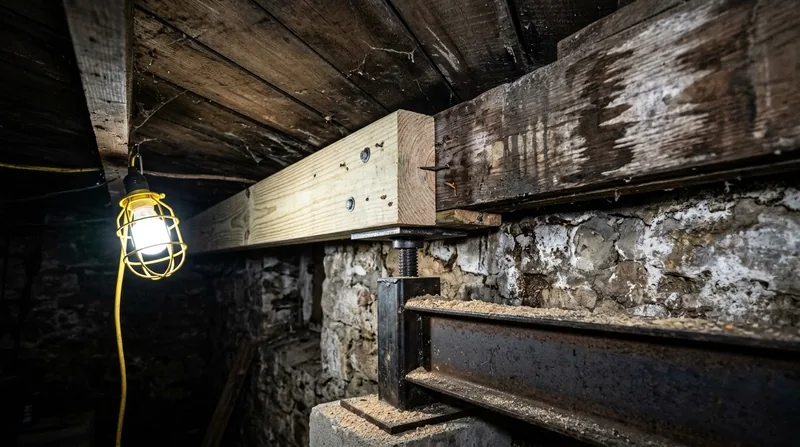




Floor Joist & Subfloor Repair in Olathe addresses one of the most common structural failures in Johnson County homes: soft, bouncy, or sagging floors caused by damp basement rim joists, old termite damage, or framing that has shifted with the area's expansive clay soil. Olathe's mix of late-1800s Victorians with tall wood basements, 1950s-60s brick-and-frame ranches on heavy clay, and newer walkout basements all sit on terrain that swells when wet and shrinks in drought, pushing rim joists and floor framing out of plumb and into decay. When a floor feels soft underfoot, slopes toward the center of the room, or creaks under normal walking, the substructure has usually absorbed moisture for months or years. We sister or replace compromised joists and rebuild subfloor sections, leveling floors before finishes go back down. The result is a solid, level floor that will hold for decades.
Why Floor Joist & Subfloor Repair Matters in Olathe Basements
Rim joists and band board in Olathe basements face relentless moisture pressure from the clay soil outside and condensation from indoor humidity. Unlike a roof leak that announces itself with a drip, rim joist decay happens quietly over years as wood absorbs groundwater and frost cycles crack the mortar joint between foundation and wood. By the time a homeowner feels the floor move underfoot, the structural damage is real. A soft subfloor is not cosmetic: it signals that the joists supporting your living space have lost load capacity and will continue to sag, crack drywall upstairs, rack door frames, and eventually require beam replacement if ignored.
- Expansive clay soil beneath Olathe homes pushes moisture up into rim joists and sill plates year-round, especially after spring thaw and heavy summer rain.
- Freeze-thaw cycles in winter crack the concrete-to-wood interface, allowing water into the rim board and the first course of floor joists.
- Eastern subterranean termites and carpenter ants follow damp wood into basement framing, hollowing out joists before visible damage appears on the floor above.
- Old hardwood or softwood joists in 1920s-50s homes are often undersized by modern standards and have less margin for decay before they fail.
- A sagging floor upstairs is proof that the basement framing has already compromised; repair now prevents far costlier beam replacement later.
Catching rim joist and subfloor rot early, before joists are completely soft, is where repair costs stay reasonable and structural integrity is fully restored.
Key info: Olathe's heavy clay and four-season freeze-thaw cycle make rim joist decay inevitable in older homes. A professional inspection of your basement framing takes one visit and costs nothing; ignoring soft spots in floor framing costs tens of thousands when the joists fail completely and a beam becomes necessary.
For more on identifying decay before it spreads, see our guide to Wood Rot & Dry Rot Repair in Olathe.
How We Repair Floor Joists & Subfloor in Olathe Homes
Our process begins with a detailed inspection of the basement rim board and joists, identifying which wood is soft, which can be saved, and which must come out. We photograph the damage, document findings, and explain what repair versus replacement means for the cost and timeline. Once you approve the scope, we work in stages: remove the compromised section of joist or subfloor, install new framing or sister the existing joist with new lumber, level the floor, and install new subfloor before finishes go back down. For homes with termite damage, we work from your pest control report and replace the affected wood; we do not treat the termites ourselves.
- We inspect the entire rim board and band board to find all soft or spongy wood, not just the spot where the floor sags.
- We determine which joists can be sistered (reinforced with new lumber bolted alongside) and which must be cut out and replaced entirely.
- We replace subfloor sections with new CDX plywood, fastened with ring-shank nails or structural screws for lasting stiffness.
- We level the floor using temporary posts and new lumber, bringing slopes back to true before the homeowner walks on it again.
- We leave the basement rim and joists unpainted or sealed so future moisture is visible and future inspectors can spot new decay early.
The goal is a floor that feels solid underfoot and will not move or creak under normal living loads.
Real example: A 1950s ranch in Olathe with a finished basement had a soft spot in the floor above the northeast corner, where the rim board faced the wettest clay and the oldest termite damage. We exposed the rim board, found four feet of spongy wood, sistered the two salvageable joists with new pressure-treated lumber, replaced the rim board with new pressure-treated band, and installed new subfloor. The floor is now level and solid, and the homeowner can finish the basement without fear of future movement.
Related structural work often involves Framing & Structural Carpentry to tie new joists into existing beams and ensure proper load paths.
Floor Joist & Subfloor Repair Methods in Olathe
| Approach | Description | Best for |
|---|---|---|
| Sistering | New joist bolted alongside existing joist to share load; old joist remains in place and provides lateral bracing. | Joists with surface rot or minor decay that have not lost more than 25-30 percent of cross-section; cost-effective and fast. |
| Full Joist Replacement | Old joist cut out, new joist installed and bolted to rim board and beam; new subfloor fastened to new joist. | Joists with deep rot, old termite galleries, or structural failure; mandatory when decay is too extensive to repair. |
| Rim Board Replacement | Existing rim board removed, new pressure-treated band board installed and bolted to foundation and rim joist ends. | Decay localized to the rim board itself; common in Olathe homes where the foundation-to-wood joint absorbs groundwater. |
| Subfloor Patching | Soft or delaminated subfloor cut out and replaced with new CDX plywood, fastened with ring-shank nails or screws. | Subfloor damage that does not extend to joists; restores stiffness and eliminates creaking or bounce. |
| Floor Leveling | Temporary posts and shims used to lift sagging section back to level before joist repair is fastened and subfloor is installed. | Any repair where slope or sag is visible; ensures doors close properly and prevents future drywall cracks upstairs. |
Each method is chosen based on the extent of decay, the load the joist carries, and whether the wood can be saved or must be replaced. A professional inspection determines the right approach for your home.
Floor Joist & Subfloor Repair Cost in Olathe: What to Expect
Floor Joist & Subfloor Repair in Olathe starts at $1,800 for a single soft joist or a small section of rim board, and scales upward based on the number of joists involved, the length of rim board to replace, and whether the subfloor must also be rebuilt. A typical project affecting three to four joists and a section of subfloor runs between $3,500 and $6,000. Larger jobs involving multiple bays of framing, extensive termite damage, or floor leveling across a whole room can exceed $8,000. The main factors that move cost are the linear feet of rim board to replace, the number of joists that need sistering or full replacement, whether the basement is finished (which complicates access and requires more careful sequencing), and whether the floor must be leveled as part of the repair.
Getting two or three estimates is smart: each contractor will assess the decay differently, and some wood that one carpenter says must be replaced can often be sistered and saved. We encourage you to ask each estimator which joists they believe are salvageable and why. See our pricing page for typical ranges and what drives cost on structural carpentry jobs.
We document all damage with photos and written findings so you can share the inspection with your insurance company if the damage qualifies for a claim. We help you gather the right paperwork, but we cannot promise a claim will be approved or that the insurer will cover the deductible.
Floor Joist & Subfloor Repair Near Me: What Olathe Homeowners Should Know When Hiring a Carpenter
Structural carpentry requires more than speed and a toolbelt. The carpenter you hire should understand load paths, know which wood can be saved and which cannot, and communicate clearly about what the repair will cost and how long it will take. When you call for an estimate, ask the contractor whether they have experience with the age and style of your home, whether they have sistered joists in Olathe clay basements before, and whether they can work around a finished basement if you have one. Fully insured coverage is standard; ask to see the certificate before work begins. If your repair involves a load-bearing wall alteration or a beam replacement, a licensed structural engineer and a permit from the Olathe Building Department are commonly required, so confirm that your contractor understands the local rules and will obtain a permit if needed.
- Request a detailed written estimate that lists each joist or rim board section, the method (sister or replace), and the subfloor area to be rebuilt.
- Check references from past customers in Olathe or nearby Johnson County towns who had similar basement framing work done.
- Ask whether the contractor has worked with your city or county building department on permit requirements for structural repairs.
- Confirm that the estimate includes floor leveling and that the contractor has a method to check level before and after the repair.
- Understand the timeline: most joist repairs take two to five days depending on the number of joists and whether the basement is finished.
- Verify that the contractor carries liability insurance and will protect your finished basement floors and walls during the work.
The same carpenters who do your repair should also be the ones who explain it, not a salesman who hands you off to a crew. That personal continuity is how mistakes are caught and quality is kept high.
Call us at (913) 355-6186 for a free, no-obligation inspection and estimate. Contact us online if you prefer to schedule by email.
Floor Joist & Subfloor Repair in Olathe: Pricing Guide
| Service | Price | Details |
|---|---|---|
| Single joist repair or rim board section | Starting at $1,800 | Includes inspection, sistering or replacement of one joist or four to six feet of rim board, new subfloor patch, and floor leveling. |
| Multiple joists or extensive rim board | $3,500 to $6,000 | Three to four joists sistered or replaced, eight to twelve feet of rim board, subfloor rebuilding, and full floor leveling to eliminate sag. |
| Large-scale basement framing or termite damage | On estimate | Entire bay replacement, extensive termite galleries, or finished basement complicating access requires on-site inspection to price accurately. |
| Travel and site visit | Included | No separate mileage or call-out fee within Olathe and surrounding Johnson County service areas. |
| Estimate | Free | Detailed written inspection with photos and cost breakdown, response within 24 hours at (913) 355-6186, no obligation to book. |
Indicative pricing, the exact cost depends on square footage, finish, and site access. Free personalized estimate within 24h at (913) 355-6186.


